
Patchwork City: What Indianapolis’s road budget can—and can’t—repair
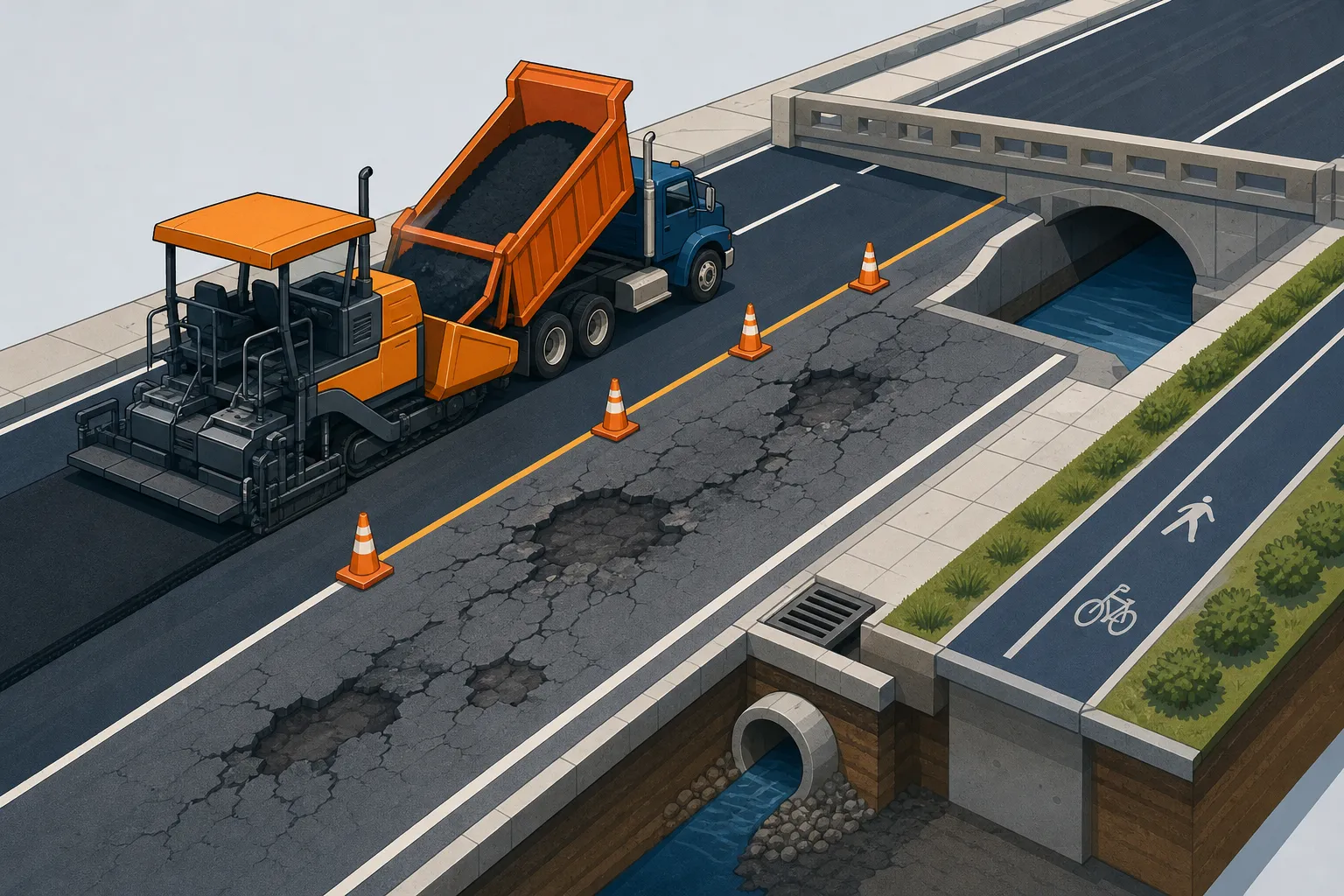
Indianapolis has more money planned for infrastructure, but a bigger capital number does not translate directly into smoother pavement. The city maintains nearly 8,400 lane miles of streets, according to its Vision Zero materials. Its 2026 public works capital plan totals $279 million, with $218 million assigned to transportation and about $62 million to stormwater. Those rounded figures cover bridges, sidewalks, drainage and other work as well as street surfaces.
Indianapolis has more money planned for infrastructure, but a bigger capital number does not translate directly into smoother pavement. The city maintains nearly 8,400 lane miles of streets, according to its Vision Zero materials. Its 2026 public works capital plan totals $279 million, with $218 million assigned to transportation and about $62 million to stormwater. Those rounded figures cover bridges, sidewalks, drainage and other work as well as street surfaces.
The distinction matters when judging the construction schedule. In its 2026 season announcement, the Department of Public Works listed 48 lane miles of asphalt street work and 170 lane miles of streets assessed for strip-patching. An assessment is not a promise that every one of those miles will be patched. Nor does the 48-mile figure represent all of the department's activity. Dividing the entire $279 million plan by 48 would wrongly treat a bridge, a storm sewer and a mile of paving as the same expense.
One west-side project shows how a large road job crosses budget years. The city described a $30.5 million rehabilitation of more than 22 lane miles of Girls School Road, from Perimeter Road to 21st Street. Its construction-season account said utility relocation was underway, with most construction expected in 2027 and 2028. The plan also includes a shared-use path and drainage features. A budget allocation in 2026 is therefore not a claim that drivers will see the finished roadway in 2026.
State aid has changed, too. Indianapolis officials have long objected to road distributions based on centerline mileage, which do not fully reflect the extra pavement on multilane streets. But it would be misleading to say that state road funding now counts only the city's roughly 3,400 centerline miles. A separate lane-mile direct distribution began in June 2026. The Indiana State Comptroller said eligible local governments receive shares based on lane miles reported to INDOT; eligibility depends on a vehicle or wheel tax and a transportation asset plan. The comptroller reported $32.6 million distributed statewide to 104 units in 2026. That memo does not establish how much Indianapolis itself received.
A separate state program could provide Indianapolis $50 million each year starting in 2027. The city must supply a local match from new revenue to qualify. The city's enacted General Ordinance 44 says that match must grow through 2031. It also says failure to provide a required match in any year ends eligibility for subsequent state payments, and the city must notify the comptroller by Dec. 31 before a transfer. This conditional $50 million is not the same program as the statewide lane-mile distribution.
To create a dedicated local revenue stream, the City-County Council enacted a $100 annual excise surtax for covered passenger vehicles and a $240 wheel tax for specified heavier vehicle classes, paid at registration. The ordinance restricts the receipts to construction, reconstruction or repair of curbs, sidewalks, streets and roads. Those amounts are enacted fees, not a measurement of dollars already collected or a list of contracts already awarded.
The new fees do not, on their own, establish a 2027 construction schedule. State matching aid, local tax receipts, appropriations and completed paving are separate milestones.
The useful test now is practical: which projects receive appropriations, when crews start and finish them, and whether measured pavement conditions improve. DPW's own project-selection materials describe pavement condition, traffic, crash history and service requests as inputs. Residents can report damaged pavement through RequestIndy, but a report is neither a guarantee of immediate repair nor a guarantee that a vehicle-damage claim will be paid. Until the city publishes the next project schedule and results, the larger funding figures show capacity and intent—not a cure for every rough block.
Report a correction · Editorial standards · Our source directory
BusinessIndy examines this development and its implications for Indiana businesses and communities using the linked sources.
Continued verification is in progress.
Sources
Publication date of the linked source has not been verified. Developed from independently authored evidence with a verified research contribution. Prepared with AI assistance; source-dependent claims remain attributed in the article.
Related coverage
- U.S. Consumer Price Index rose 0.6% in September 2026; 12‑month inflation 3.7%, BLS says
- Shelbyville announces open house and $3.41M plan to widen half‑mile of Amos Road
- Free legal help available for eligible Indiana flood survivors
Reader discussion
Join the discussion. Every comment is checked before publication. Community rules and appeals