
Growing Without Losing the Square: Danville’s Business Development Balancing Act
In the Hendricks County seat, the path to a stronger economy runs through historic storefronts, commercial corridors and a question of community identity.
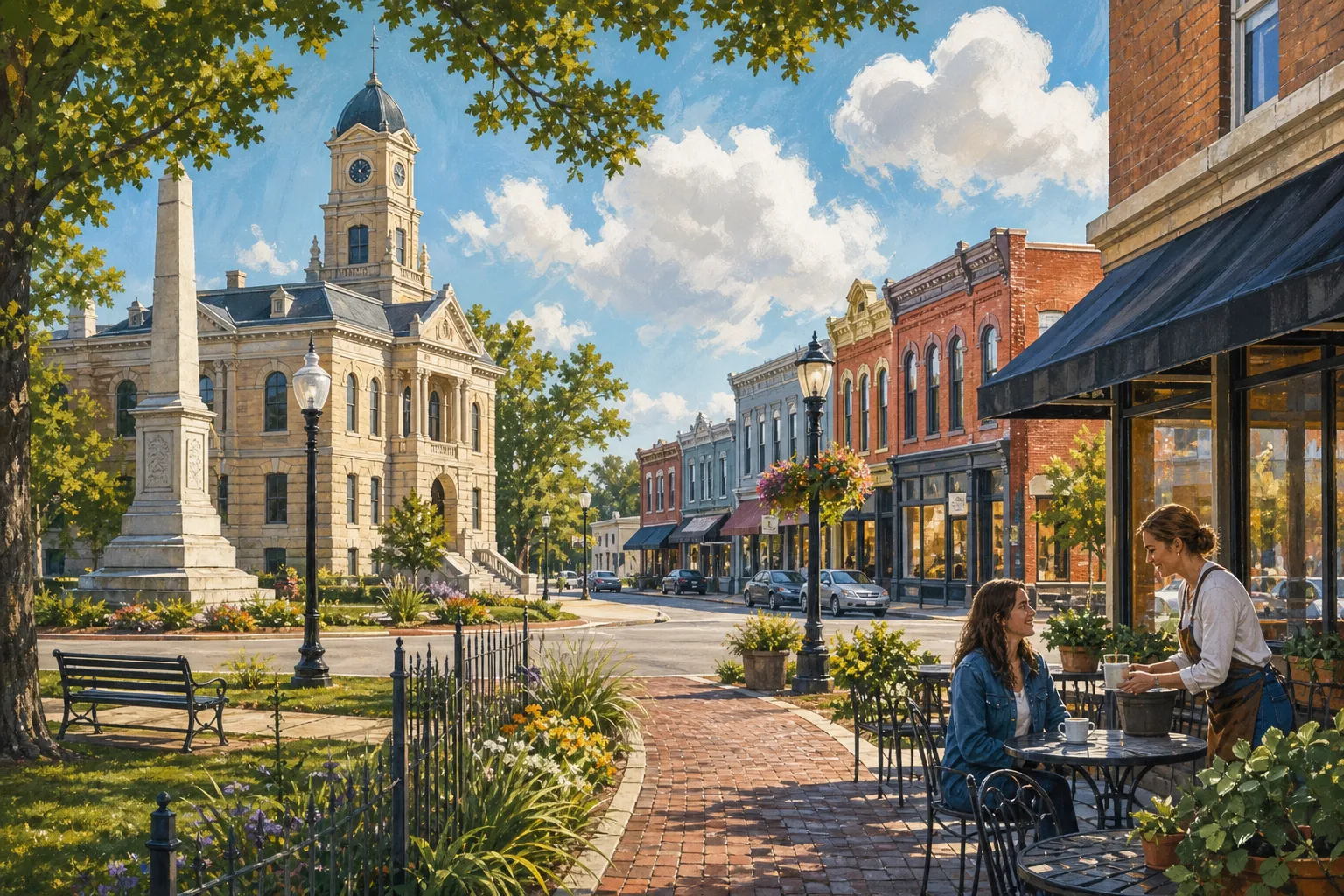
In the Hendricks County seat, the path to a stronger economy runs through historic storefronts, commercial corridors and a question of community identity.
DANVILLE, Ind. — For Danville, business development is about more than finding room for the next business. It is about deciding what growth should look like — and how much of the town’s future can be built around the places that already define it.
The historic courthouse square sits at the center of that discussion. Regional economic-development and tourism agencies promote the square’s shops, restaurants and historic atmosphere as assets that draw residents and visitors. [1] [4] Danville’s planning documents outline a complementary ambition: strengthen local businesses downtown while accommodating a broader mix of commercial development along U.S. 36 and Main Street. [1] [2]
That creates a development story centered on balance: attracting investment without weakening the small-town character that makes Danville distinctive.
A downtown built for reinvestment
Danville’s downtown strategy begins with a practical limitation. The town’s comprehensive plan, adopted January 19, 2022, describes the downtown as built out, leaving its future dependent on infill and redevelopment rather than construction on undeveloped land. [2]
The distinction matters. Growing a business district within an established downtown requires a different approach from developing a new commercial site. In Danville’s planning framework, that means finding productive uses for existing buildings and underused properties while preserving the scale of the streetscape.
The document favors buildings of one to three stories, locally owned businesses at street level and offices or housing above. It also encourages specialty retail and additional downtown housing — a combination intended to bring more activity to the district without replacing its basic character. [2]
The vision is not simply to preserve attractive buildings. It is to keep those buildings economically useful.
An occupied upper floor, a renewed storefront or a new use for an overlooked property would fit that approach. Rather than treating preservation and development as competing goals, the plan connects them: reinvestment can help historic spaces remain part of the town’s working economy. [2]
Two settings, different opportunities
Danville’s planning documents distinguish between the courthouse square and the town’s larger commercial corridors.
Downtown is identified as a place to emphasize local establishments. Along U.S. 36 and Main Street, the framework allows for a mix of local and chain businesses. That distinction provides a way to accommodate different types of investment without expecting every business to fit the same setting. [2]
For the square, the priorities are specific and practical. The planning document calls for encouraging longer business hours, reserving convenient parking for customers, supporting small businesses through incentives and preparing an inventory of vacant or underused space. [2]
Those proposals put attention on the everyday workings of a commercial district. Recruiting a new shop is one part of development; helping customers reach it, identifying a suitable space and creating reasons to stay downtown are others.
The document also recommends expanding business retention and expansion efforts with the Hendricks County Economic Development Partnership, alongside stronger support for entrepreneurship. Its emphasis extends beyond bringing companies into town to helping businesses already there remain and grow. [2]
The community is part of the pitch
Danville’s economic-development message reaches beyond commercial property.
The Hendricks County Economic Development Partnership highlights Danville’s parks, recreation and education as part of its appeal to residents and employers. Its community profile points to school programs involving robotics, engineering, CNC machining, welding and logistics, along with advanced-placement and dual-credit opportunities. [1]
Those offerings give the town a workforce-development story to tell, although the existence of school programs alone does not establish how many graduates enter local jobs.
The same regional profile promotes the historic square and recreational amenities alongside education. The underlying proposition is straightforward: Danville is marketing a place to live as well as a place to operate a business. [1]
The Greater Danville Chamber of Commerce’s economic-development page places historic downtown Danville alongside Danville Commercial Park and other development sites. It also directs business owners to the Indiana Small Business Development Center for no-cost advising and training. [3]
Growth requires public confidence
Danville’s planning record also acknowledges that development can meet resistance.
The 2022 plan describes hesitation toward growth around a controversial planned unit development on the town’s west side. That passage reflects the circumstances when the document was prepared, not a measurement of current public opinion. Still, it reveals an important challenge behind the town’s economic goals: residents’ confidence in how development happens. [2]
The same document pairs business attraction with preserving community character, improving walkability and strengthening local establishments. Rather than presenting growth as an end in itself, it sets out a framework in which development should reinforce the community around it. [2]
The next chapter
Danville’s development ambitions are visible in its plans: more productive use of downtown property, stronger existing businesses, room for new commercial investment and a closer connection between economic opportunity and community character. Those are stated goals, not a verified tally of completed projects or new jobs. [2]
What makes the town’s approach distinctive is the role assigned to its historic center. The square is not treated as something to leave behind as development moves outward. It is positioned as an asset worth building around. [1] [2]
The central question for Danville is therefore not simply how much business it can attract. It is how new investment can support the local establishments, useful buildings and recognizable streets that give the town its identity in the first place.
Sources
1. Hendricks County Economic Development Partnership — Danville community profile
https://hcedp.org/communities/danville/
2. Town of Danville — Comprehensive Plan adopted January 19, 2022
https://danvillein.gov/egov/documents/1643645957_66615.pdf
3. Greater Danville Chamber of Commerce — Economic development and business resources
https://www.danvillechamber.org/57128-2/
4. Visit Hendricks County — Danville destination profile
https://www.visithendrickscounty.com/towns-and-regions/danville/
Report a correction · Editorial standards · Our source directory
BusinessIndy examines this development and its implications for Indiana businesses and communities using the linked sources.
Continued verification is in progress.
Sources
- Town of Danville: Growing Without Losing the Square: Danville’s Business Development Balancing Act ↗
- Hendricks County Economic Development Partnership: Danville community profile ↗
- Greater Danville Chamber of Commerce: Economic development and business resources ↗
- Visit Hendricks County: Danville destination profile ↗
Developed from independently authored evidence with a verified research contribution. Prepared with AI assistance; source-dependent claims remain attributed in the article.
Related coverage
- York Automotive’s Plainfield dealership donates part of every lease or purchase to local nonprofits via ‘Drive to Donate’
- Pittsboro’s data-center question: what followed the Vantage zoning vote?
- The Boxes Next Door: A Brownsburg truck-lot vote tests Hendricks County’s logistics bargain
Reader discussion
Join the discussion. Every comment is checked before publication. Community rules and appeals