
The Boxes Next Door: A Brownsburg truck-lot vote tests Hendricks County’s logistics bargain
A 31-space truck lot is a small parcel in a county shaped by much larger logistics decisions. Yet the Brownsburg Advisory Plan Commission’s September 28 vote on Lion’s Trans Inc. shows how the costs and benefits of that growth can be judged differently even within one town hall.
A 31-space truck lot is a small parcel in a county shaped by much larger logistics decisions. Yet the Brownsburg Advisory Plan Commission’s September 28 vote on Lion’s Trans Inc. shows how the costs and benefits of that growth can be judged differently even within one town hall.
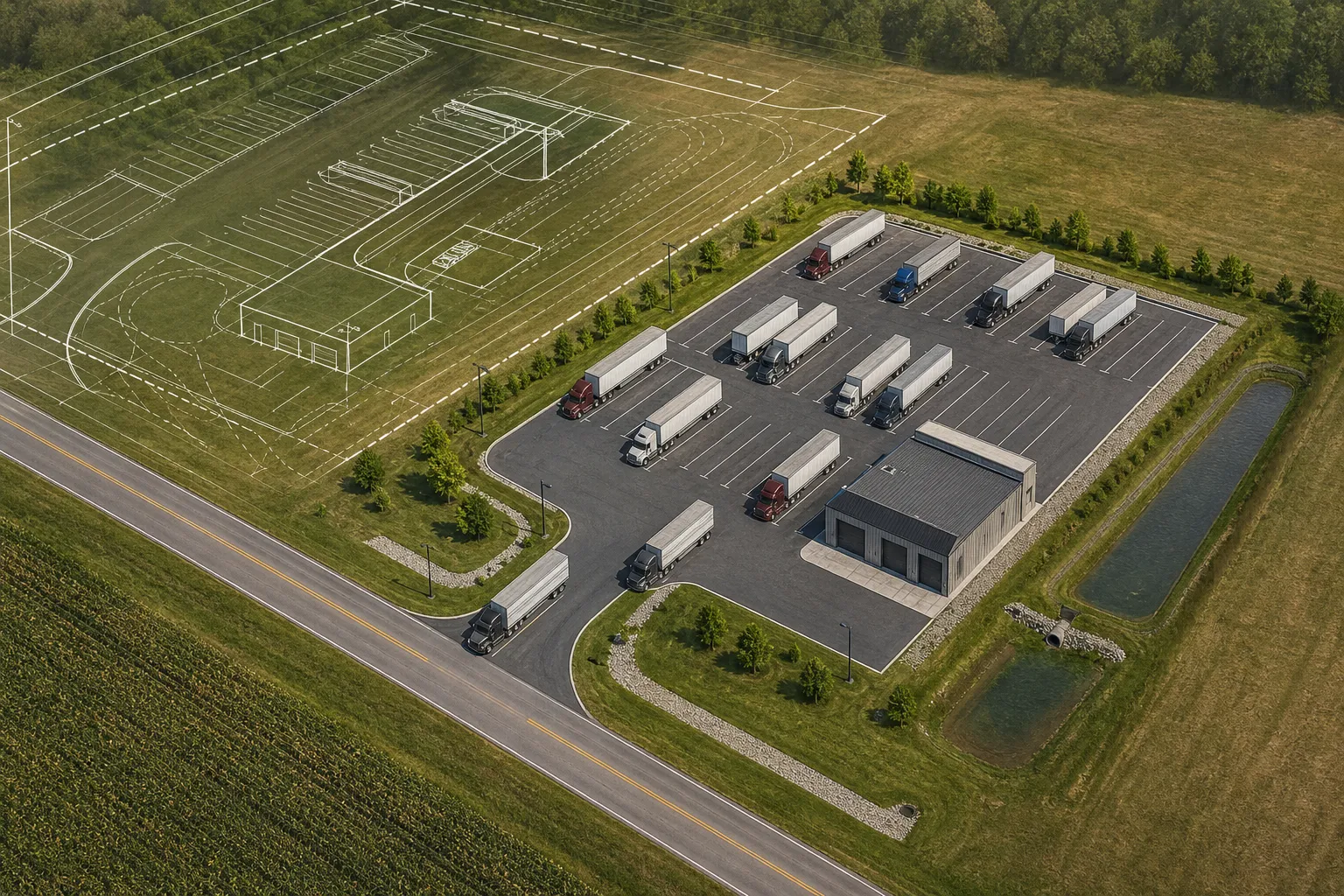
The commission voted 5–0 to approve a development plan at 4005 N. County Road 1000 East. Town records describe a 3.07-acre site with 31 semi-truck and trailer spaces and a proposed 2,860-square-foot maintenance building. The applicant said trucks would arrive and leave at different times, and described the project as a safe place for drivers to park and rest, with repair services available. Approval of a plan is not evidence that the facility has been built or opened.
Planning staff made no recommendation. Its report said the use was permitted but questioned whether the scale and design supported Brownsburg’s comprehensive plan. Staff remained concerned about truck maneuvering on and off the property and the condition of the county road. The report states plainly that no traffic study was submitted for this project. It also says the lot would be used predominantly for truck parking, rather than for an industrial employer of the kind the plan envisions.
Those concerns did not amount to a finding that trucks had already damaged the road or that a collision was likely. They were unresolved planning judgments. The commission’s subsequent findings took the opposite position on the key land-use question: the approved plan, it found, was consistent with the comprehensive plan and applicable development standards. The same document retains staff’s objections. Reading the two positions together reveals the decision the town actually made, not a unanimous technical endorsement.
The application changed during review. Staff’s addendum says a separate office building was removed from the plans and lists responses to requests about the entrance, drainage, landscaping and stormwater maintenance. The project did not seek a variance, according to the staff report. Approval therefore centered less on whether a truck-related use could legally occur there than on how this particular layout would work at that location.
Hendricks County’s logistics economy does not have one development model. Plainfield, closer to the airport and I-70, explicitly offers qualifying businesses property-tax abatements and uses tax-increment financing to support incentives or infrastructure in designated areas. Its economic-development materials also point to MADE@Plainfield, a training partnership, and the Plainfield Connector, an employee transportation service supported through an economic improvement district. Those are townwide tools, not proof that this Brownsburg applicant received a tax break or that its project will fund comparable services.
That distinction matters when a proposal is discussed as “growth.” A parking and maintenance site may serve drivers and freight operators, while the public questions at a particular intersection concern turning space, road condition and stormwater upkeep. Neither the applicant’s description of a benefit nor staff’s caution supplies a measured traffic count. The published Brownsburg record does not establish a construction date, a number of new jobs or a final public cost for road work tied to this plan.
The next test is in the implementation record. Residents and businesses can look for stamped construction plans, entrance and drainage details, permits and any later traffic or road-improvement commitments. The town and the county road authority can clarify who is responsible for improvements and maintenance, and whether actual operations match the staggered-use account presented to the commission. Those are questions for follow-up, not outcomes already proved by the September vote.
The Brownsburg case is not every warehouse in Hendricks County. It is a concrete example of the bargain that accompanies a logistics cluster: a permitted project can still leave reasonable questions about the roads and services around it. The public record now makes those questions specific enough to track.
Report a correction · Editorial standards · Our source directory
BusinessIndy examines this development and its implications for Indiana businesses and communities using the linked sources.
Continued verification is in progress.
Sources
- Current (YouAreCurrent): The Boxes Next Door: Hendricks County's Warehouse Reckoning ↗
- brownsburgfire.org ↗
- www.brownsburg.org ↗
- www.townofplainfield.com ↗
Publication date of the linked source has not been verified. Developed from independently authored evidence with a verified research contribution. Prepared with AI assistance; source-dependent claims remain attributed in the article.
Related coverage
- York Automotive’s Plainfield dealership donates part of every lease or purchase to local nonprofits via ‘Drive to Donate’
- Pittsboro’s data-center question: what followed the Vantage zoning vote?
- Hendricks County schools awarded more than $644,000 in state secured-school safety grants
Reader discussion
Join the discussion. Every comment is checked before publication. Community rules and appeals